


A single annual penetration test often fails to capture the true risk profile of a modern, evolving network. According to the 2023 Cyber Security Breaches Survey, 39% of UK businesses identified a cyber attack in the last 12 months, yet many still rely on point-in-time assessments that provide a false sense of security. You likely understand the pressure of maintaining a complex hybrid infrastructure while striving to meet rigorous standards like ISO 27001 or Cyber Essentials Plus. It’s a significant challenge for any enterprise in redditch to ensure their defensive posture remains resilient against sophisticated threats.
This guide offers a strategic roadmap for infrastructure hardening and enterprise-grade security assurance. We’ll show you how to move beyond basic automated scans toward human-led adversary simulations that deliver genuine peace of mind. You’ll learn how our CREST-accredited methodology and the Pentesys Portal provide the actionable remediation guidance required to transform vulnerabilities into long-term resilience. We’ll also examine how continuous monitoring and professional expertise bridge the gap between technical execution and business value.
Key Takeaways
- Understand how the transition to cloud-first environments has reshaped the threat landscape for Redditch organisations and why static perimeters no longer provide sufficient protection.
- Identify the critical limitations of automated scanning and how human-led adversary simulations uncover complex logic flaws that software tools often miss.
- Learn to implement a comprehensive defense strategy by combining external attack surface assessments with internal “assumed breach” testing scenarios.
- Utilise a professional 5-step framework to verify the technical certification and CREST accreditation of potential cybersecurity partners.
- Discover how the Pentesys Portal facilitates continuous security visibility, transforming point-in-time assessments into a managed strategy for long-term resilience.
Infrastructure Security in 2026: The Evolving UK Threat Landscape
The security architecture of the average UK business has undergone a total transformation. By 2026, the traditional static network perimeter has largely vanished, replaced by dynamic, cloud-first environments that support remote and hybrid workforces. For an organisation in redditch, this shift brings agility but also introduces significant complexity. Threat actors now prioritise these distributed infrastructures, seeking out misconfigurations in cloud permissions and unsecured APIs that didn’t exist five years ago.
Strategic risk management now depends on offensive security. This proactive stance involves identifying vulnerabilities before they’re weaponised by adversarial groups. A human-led penetration test is the most effective way to gain this insight. It moves the conversation away from simple automated scans toward a deeper understanding of how a sophisticated attacker might actually navigate your specific network. It’s a method that prioritises human intelligence to find the logic flaws that software often misses.
Transitioning to a culture of continuous security validation is essential. The era of the “once-a-year” check is over. UK firms are adopting a steady rhythm of assessment to ensure that new deployments don’t introduce fresh risks. This managed process builds a narrative of reliability, turning cybersecurity from a technical hurdle into a core business asset that supports long-term growth and stability. Using the Pentesys Portal, organisations can track this journey in real-time, moving from reactive patching to a state of constant readiness.
The Rise of Ransomware and Supply Chain Attacks
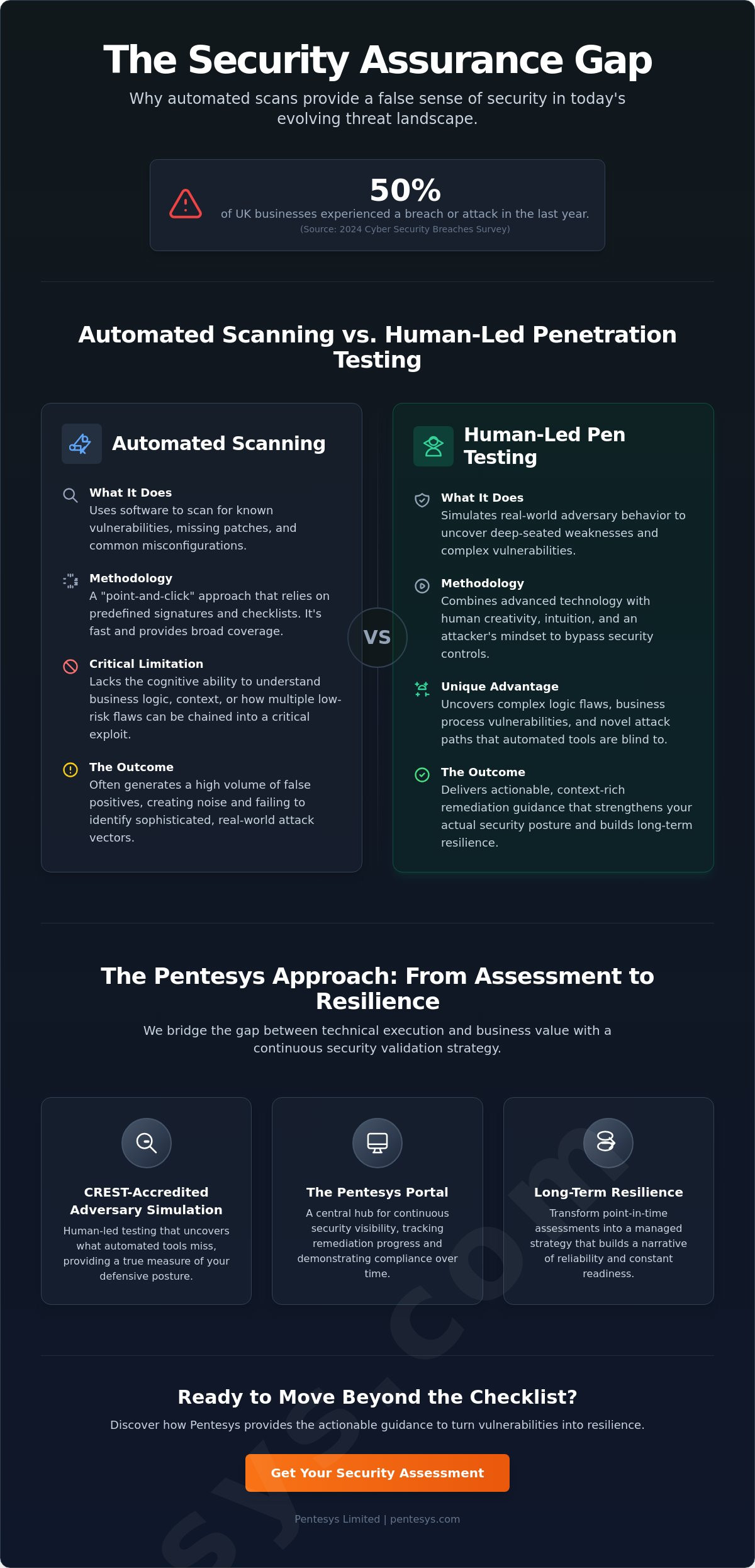
Threat actors in 2026 are highly specialised. They frequently target the supply chain to gain access to multiple high-value victims simultaneously. Data from the 2024 Cyber Security Breaches Survey indicates that 50% of UK businesses experienced a breach or attack within the last year, with ransomware remaining a primary tool for extortion. When special category data is leaked, the reputational fallout can be terminal. Businesses must adopt a business-centric security model where protection is aligned with corporate goals, ensuring that critical assets remain shielded regardless of IT infrastructure changes.
Regulatory Pressures and Compliance Mandates
The UK regulatory environment has become more stringent to combat rising threats. Frameworks like ISO 27001 and Cyber Essentials Plus now require evidence of rigorous, ongoing testing rather than just policy documentation. For firms in redditch, regular testing serves as a cornerstone for these mandatory audits. Enterprise-level contracts increasingly demand transparent security reporting. By integrating regular assessments into their operations, organisations meet these legal obligations while providing the technical assurance that partners and stakeholders now expect as standard.
Human-Led Penetration Testing vs. Automated Vulnerability Scanning
Effective infrastructure security distinguishes between simple vulnerability identification and true adversary simulation. Penetration testing is a human-led simulation of real-world attack vectors, designed to uncover deep-seated weaknesses that software cannot perceive. While automated tools excel at identifying known software versions or missing patches, they lack the cognitive flexibility to understand complex business logic. Technical authority in cybersecurity requires human intuition to bypass sophisticated security controls and identify how disparate, minor flaws can be combined to compromise an entire network.
The Pentesys philosophy rejects the “point-and-click” scanning methodology. We combine advanced technology with expert offensive intelligence to provide a comprehensive security posture. For organisations in redditch, this approach is vital to meet the resilience objectives defined in the UK Government Cyber Security Strategy. Official 2024 data indicates that 50% of UK businesses identified a cyber breach or attack in the previous 12 months, proving that static defenses are no longer sufficient. Our methodology ensures that your security assessment is a strategic asset rather than a generic checklist.
The Value of Adversarial Intuition
Human testers provide a level of depth that automation cannot replicate. An expert consultant chains minor vulnerabilities together to achieve critical exploits, mirroring the persistence of a real-world threat actor. Automated scans often miss “unscannable” risks in custom web applications and APIs where the flaw lies in the logic, not the code syntax. A strategic security assessment provides a narrative of risk, explaining how an attacker could move laterally through your redditch office network, whereas a vulnerability list merely provides a disconnected series of technical tasks. You can strengthen your resilience by focusing on these human-centric insights.
When to Use Automated Monitoring
Automation remains a critical component of a modern security strategy when used correctly. By 2026, continuous external attack surface monitoring will be the standard for maintaining a baseline between annual deep-dive assessments. These tools track rapid changes in your digital footprint, identifying new subdomains or misconfigured cloud buckets in real-time. Integrating this automated data into a human-led remediation strategy ensures that security is a managed, ongoing process. We deliver these insights through the Pentesys Portal, allowing your team to track remediation progress and maintain enterprise-grade security 365 days a year.
Internal vs. External Security Assessments: Building Comprehensive Defense
Building a resilient infrastructure for Redditch businesses requires a clear understanding of where assets are vulnerable. We divide this process into two distinct but complementary areas: the external perimeter and the internal network. Relying on a single layer of security is no longer sufficient when 82% of breaches involve data stored in the cloud or on-premise servers that were accessible through overlooked entry points.
External Infrastructure Hardening
External testing identifies the gaps in your public-facing perimeter. Misconfigured firewalls remain a primary entry point, often caused by overly permissive rules or legacy configurations that remain active long after their purpose has expired. For organisations utilising cloud-hosted environments, we evaluate AWS S3 buckets and Azure storage accounts for accidental public exposure. Our human-led testing ensures that public-facing APIs and web gateways aren’t just functional, but hardened against sophisticated exploits. This methodology aligns with the NCSC guidance on penetration testing, which highlights the importance of regular assessments to manage external risks effectively. We don’t just find the open port; we provide the remediation guidance to close it permanently.
Internal Network Resilience
Internal network resilience focuses on the damage an attacker can do once they’ve gained a foothold. We simulate insider threats and lateral movement to see how easily a low-level user account could escalate to Domain Admin. Statistics from 2024 show that 74% of breaches involved a human element, including social engineering or the misuse of internal permissions. We test Active Directory for vulnerabilities like Kerberoasting or insecure Group Policy Objects (GPOs) that allow attackers to move through your Redditch office network undetected. In 2026, the assumed breach mindset operates on the certainty that a perimeter bypass will occur, shifting the security focus from prevention to the rapid containment of an active adversary within the internal environment.
Securing the hybrid workforce is the final piece of the puzzle. We test VPN resilience and Multi-Factor Authentication (MFA) implementation to ensure that remote access doesn’t become a weak link. Automated scans often miss the subtle bypasses in MFA logic that a human expert will find. Through the Pentesys Portal, we provide a structured view of these vulnerabilities, moving from broad value propositions to specific operational stages. This allows your technical team to prioritise fixes that offer the greatest strategic impact on your long-term resilience.
Evaluating a Cybersecurity Partner: A 5-Step Assurance Framework
Selecting a security provider requires a methodical approach that prioritises technical rigour over marketing claims. For Redditch organisations, the goal is to secure a partnership that offers more than a checklist exercise. This 5-step framework ensures your chosen partner provides genuine assurance. It’s about moving from a reactive posture to a state of continuous resilience.
- Step 1: Verify CREST accreditation. Ensure the firm holds current technical certifications. The Council of Registered Ethical Security Testers (CREST) is the benchmark for quality in the UK.
- Step 2: Human-led methodology. Assess whether the partner relies on automated scans or human intelligence. Vulnerability scanners often miss complex logic flaws that a skilled adversary will exploit.
- Step 3: Quality of remediation. Review how the partner delivers advice. You need clear, prioritised steps that your internal teams can act on immediately.
- Step 4: Real-time accessibility. Evaluate the delivery platform. Modern security teams require live data through a centralised hub like the Pentesys Portal rather than waiting weeks for a static document.
- Step 5: Compliance alignment. Ensure the testing meets specific UK standards, such as Cyber Essentials Plus or ISO 27001 requirements.
The Importance of CREST Accreditation
CREST is the gold standard for penetration testing in the United Kingdom. It provides a level of professional assurance that generalist IT firms cannot match. When you choose a CREST-accredited partner, you’re working with a team that has undergone rigorous background checks and technical assessments. This reduces corporate liability and builds significant trust with stakeholders. According to the 2024 Cyber Security Breaches Survey, 32% of UK businesses identified a breach in the last 12 months. Accredited testing is a primary defence against becoming part of that statistic.
Actionable Insights and Remediation
A PDF report is no longer sufficient for modern security teams. These documents often sit in an inbox without being addressed. Pentesys provides technical advice that speaks directly to your developers. We focus on vulnerability closure through the Pentesys Portal, allowing your team to track progress in real time. This strategic support ensures that identified risks are actually mitigated, not just documented. We provide post-test support to verify that your fixes are effective and robust. It’s a partnership-driven approach that helps Redditch enterprises maintain a secure baseline long after the initial assessment is complete.
Our methodology combines high-level adversary simulation with enterprise-grade reporting to deliver total transparency. We don’t just find holes; we help you bridge the gap between technical discovery and business value.
Strengthen your security posture with our CREST-accredited penetration testing services.
Pentesys: Delivering National-Grade Security via the Pentesys Portal
Securing a business in redditch requires a transition from reactive fixes to proactive assurance. Pentesys provides professional assurance through expert-led assessments that go beyond simple vulnerability scanning. Our approach ensures that every identified risk is contextualised within your specific business environment, providing a clear path to remediation. We help organisations move from point-in-time audits to a model of continuous vulnerability management, ensuring that security matures alongside your digital infrastructure.
Partnering with Pentesys means gaining a strategic ally focused on your long-term security health. We provide the technical authority needed to navigate complex regulatory requirements while delivering actionable insights that your executive team can understand. By choosing a partnership-driven approach, redditch firms can focus on growth, knowing their digital assets are protected by national-grade expertise and a platform built for continuous improvement.
The Power of the Pentesys Portal
The Pentesys Portal serves as your central hub for security visibility, offering a unified view of your entire attack surface. Instead of managing disparate PDF reports, your team can access real-time tracking of vulnerabilities and monitor remediation progress as it happens. This platform centralises data from infrastructure, web application, and cloud testing, allowing for a holistic understanding of your risk posture. You can read about how continuous penetration testing is transforming UK security by replacing static snapshots with ongoing protection. This shift ensures that new assets or configuration changes are captured and assessed before they can be exploited.
The Pentesys Methodology
Our methodology is built on transparency and precision, designed to integrate into your existing workflows with minimal disruption. We don’t just run tools; we apply a rigorous, step-by-step process that mirrors the tactics of real-world attackers. For mature organisations, we provide human-led red teaming and adversarial simulations that test your defensive response capabilities under realistic conditions. Pentesys remains committed to the principle that human intelligence and manual expert analysis are indispensable, refusing to rely on the automated shortcuts that often miss complex logic flaws. This dedication to quality provides the strategic peace of mind necessary for long-term resilience.
By centralising your security efforts within the Pentesys Portal, you gain more than just a list of bugs. You gain a roadmap for security maturity. Our consultants work closely with your internal teams to ensure remediation guidance is clear and actionable, reducing the time-to-fix for critical issues. This collaborative model transforms penetration testing from a mandatory annual expense into a valuable strategic asset that protects your reputation and your bottom line.
Securing Your Infrastructure for the 2026 Threat Landscape
The UK Government’s Cyber Security Breaches Survey 2024 reports that 50% of businesses identified a cyber attack in the previous 12 months. This data underscores why a tick-box approach to security isn’t sufficient for modern risks. Relying solely on automated scans leaves significant gaps; instead, human-led offensive security specialists use adversary simulation to find the complex logic flaws that software misses. By combining internal and external assessments, your organisation builds a comprehensive defense that protects critical assets from every angle.
Pentesys provides the technical authority needed to navigate these challenges with confidence. Our CREST-accredited testing methodology ensures your redditch organisation receives enterprise-grade assurance. Through the proprietary Pentesys Portal, we deliver real-time reporting and remediation guidance, making continuous monitoring a practical reality rather than a conceptual goal. This strategic approach transforms security from a chaotic event into a managed, transparent process. You gain peace of mind knowing your infrastructure is under the watch of experts who value human intuition over automated shortcuts.
Secure your infrastructure with a Pentesys expert assessment
Building a resilient future starts with the right partner. We’re ready to help you strengthen your perimeter and protect your long-term business value.
Frequently Asked Questions
What is the difference between a vulnerability scan and a penetration test?
A vulnerability scan is an automated tool that identifies known security flaws, while a penetration test is a human-led assessment that exploits those flaws to understand the depth of a potential breach. Scans provide a high-level overview of vulnerabilities, but our human-led approach simulates real-world adversary tactics. This ensures your Redditch business receives actionable insights rather than a list of false positives.
How often should our organisation conduct infrastructure penetration testing?
You should conduct infrastructure penetration testing at least once every 12 months or whenever you implement major network changes. PCI DSS 4.0 requirements mandate annual testing for compliant organisations to maintain their certification. For high-risk environments, we recommend a continuous security model to address the 22,000 new vulnerabilities discovered annually across the global threat landscape. Regular testing maintains long-term resilience.
Is penetration testing required for ISO 27001 compliance in the UK?
Yes, penetration testing is a critical component for meeting the requirements of ISO 27001:2022, specifically under Annex A 8.8 regarding the management of technical vulnerabilities. The standard requires organisations to obtain information about technical vulnerabilities and take appropriate measures. Our assessments provide the technical assurance needed to demonstrate to UKAS-accredited auditors that your security controls are effective and regularly validated.
Will a penetration test disrupt our daily business operations?
A professionally managed penetration test is designed to avoid disrupting your daily business operations. We coordinate closely with your technical team during the planning phase to define clear rules of engagement and identify sensitive systems. By using controlled exploitation techniques, we provide deep-tech execution without the risk of system downtime or service degradation for your staff or customers.
How long does a typical infrastructure security assessment take?
A typical infrastructure security assessment takes between 3 and 10 business days to complete, depending on the number of IP addresses and network complexity. Small Redditch offices might require a 3-day engagement, while larger enterprise networks with multiple VLANs often need more extensive testing. All findings and remediation guidance are delivered through the Pentesys Portal for immediate review and action.
What qualifications should a professional penetration tester hold?
Professional penetration testers should hold industry-recognised certifications such as CREST Registered Tester (CRT) or Offensive Security Certified Professional (OSCP). These accreditations ensure the individual possesses the technical competence to perform adversary simulations safely and ethically. Our team combines these certifications with human intuition to provide a level of assurance that fully automated solutions simply cannot match.
How does red teaming differ from standard penetration testing?
Red teaming is a full-scope adversary simulation that tests your organisation’s detection and response capabilities, whereas a standard penetration test focuses on identifying specific technical vulnerabilities. While a penetration test might target a specific network segment, a red team engagement simulates a multi-staged attack over several weeks. This provides a strategic view of your overall security posture and incident response effectiveness.
What happens after the penetration test is completed?
You’ll receive a comprehensive report through the Pentesys Portal that includes a detailed breakdown of vulnerabilities and specific remediation guidance. We rank risks using the Common Vulnerability Scoring System (CVSS) to help you prioritise fixes based on their potential impact. Our team remains available to provide strategic support and perform retesting to confirm that your security improvements have successfully mitigated the identified risks.