


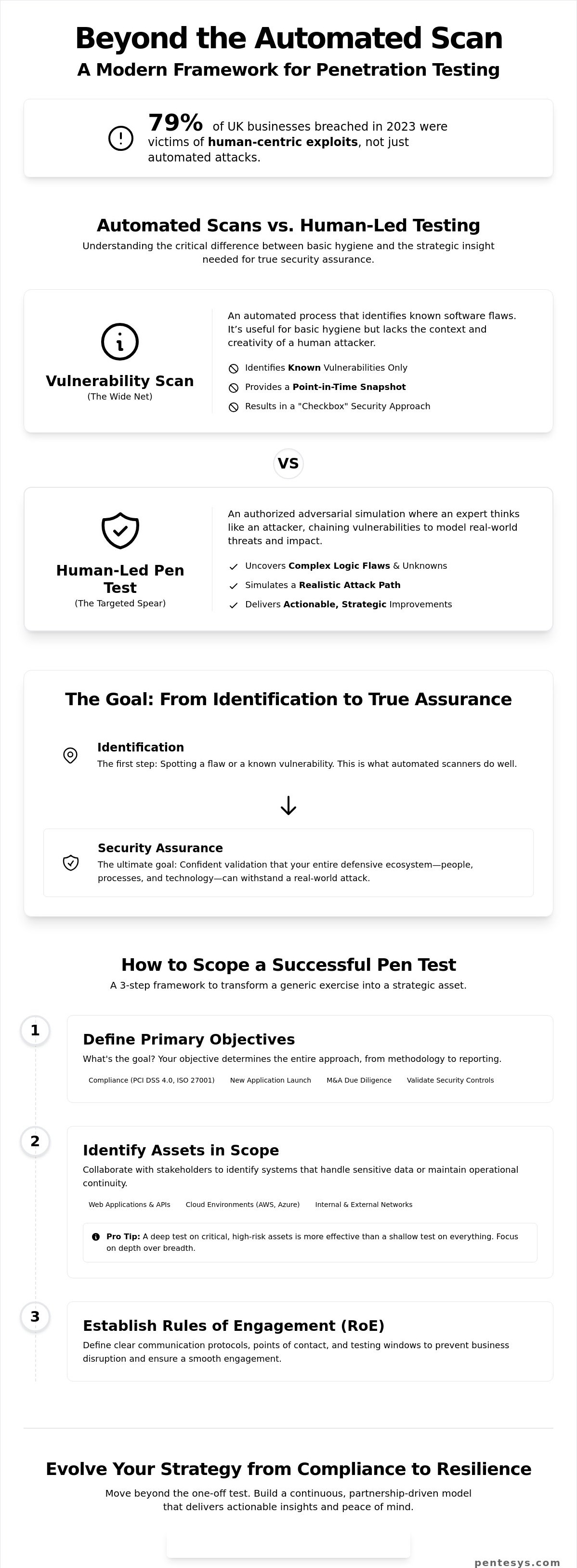
An automated scan will never replace the intuition of a human tester, yet 79% of UK businesses that suffered a breach in 2023 identified human-centric exploits as the primary entry point. You’re likely tired of receiving dense, jargon-heavy reports that provide little more than a snapshot of your vulnerabilities without a clear path forward. It’s difficult to justify the investment in pen testing when the results feel like a checkbox exercise rather than a strategic improvement to your resilience.
We believe that cybersecurity is about trust and human intelligence. This guide provides a clear framework to help you commission, scope, and action your next assessment with absolute confidence. You’ll learn how to move beyond basic scanning to achieve true security assurance that protects your business without causing operational disruption. We’ll walk through the transition from point-in-time testing to a continuous, partnership-driven model that delivers actionable insights for your technical teams and peace of mind for your board.
Key Takeaways
- Transition from basic vulnerability scanning to authorized adversarial simulations that align your security posture with strategic UK business objectives.
- Master a step-by-step framework for scoping assets, ensuring your web applications, APIs, and cloud environments are robustly defended.
- Gain insights into the value of human-led pen testing, which combines expert intuition with advanced technology to uncover complex logic flaws.
- Learn to interpret high-quality reporting and prioritise remediation efforts based on risk-based CVSS scores and actual impact on your enterprise operations.
- Evolve your strategy beyond annual compliance checks toward a model of continuous attack surface monitoring for long-term resilience.
Defining Pen Testing for the Modern Enterprise
At its core, pen testing is an authorized adversarial simulation designed to evaluate the security of an IT infrastructure. It’s an active attempt to bypass security controls and gain access to systems or data. While many organisations rely on automated tools, a true penetration test is human-led. It requires a specialist to think like an attacker, using creativity and technical skill to find paths that software often misses. You can find a comprehensive overview of penetration testing that details the various methodologies used to secure digital assets.
The distinction between a simple vulnerability scan and an expert-led test is critical. Scans are automated processes that identify known software flaws. They’re useful for basic hygiene but they lack context. An expert-led test goes deeper, chaining multiple low-level vulnerabilities together to achieve a high-impact breach. This methodology provides a realistic view of risk that automated tools cannot replicate. The National Cyber Security Centre (NCSC) often compares this process to a financial audit. Just as a financial audit provides independent verification of a company’s accounts, a penetration test provides an independent, technical verification of a company’s security posture.
The Core Objectives of Offensive Security
- Proactive Identification: Finding exploitable vulnerabilities before real-world adversaries can leverage them for data theft or ransomware.
- Control Validation: Testing the effectiveness of existing security controls, such as firewalls and intrusion detection systems, and the response times of internal security personnel.
- Compliance and Evidence: Meeting strict UK regulatory requirements, including GDPR and ISO 27001, by providing technical evidence that security measures are operational and effective.
Assurance vs. Identification: Why the Distinction Matters
Knowing a vulnerability exists is only half the battle. Identification is the act of spotting a flaw; assurance is the process of proving that your entire defensive ecosystem can withstand an attack. Many businesses find that while they’ve identified a bug, their internal remediation and patching processes fail to fix it correctly. A penetration test validates these internal workflows. Security Assurance is the confident validation of defensive measures.
For UK enterprises, this distinction is the difference between a “tick-box” compliance exercise and genuine resilience. Cyber insurance providers now frequently demand evidence of regular testing before offering coverage. By moving beyond simple identification, organisations build long-term trust with stakeholders and regulators alike. This strategic approach ensures that security is a managed, ongoing process rather than a series of disconnected reactions to threats.
How to Scope a Penetration Test: A Step-by-Step Framework
Effective scoping is the foundation of a successful security engagement. It transforms a generic exercise into a strategic asset that provides genuine assurance. Without a clear scope, testing teams may waste hours on low-priority assets while missing critical vulnerabilities in your core infrastructure. The NIST definition of pen testing emphasises the importance of mimicking real-world attack patterns to identify security gaps, and this requires a precise understanding of your environment.
Your first step involves defining the primary objective. An organisation seeking compliance with PCI DSS 4.0, which became mandatory in March 2024, will have different requirements than a startup launching a new fintech application. Once you establish the goal, you must identify the assets in scope. This includes web applications, APIs, cloud environments, and internal networks. Clear communication protocols and a defined testing window are essential to prevent business disruption; testing production environments during peak UK business hours requires careful coordination and established Rules of Engagement (RoE).
Defining Your Testing Boundaries
Identifying critical business assets is a collaborative process between security teams and stakeholders. You should focus on systems that handle sensitive data or maintain operational continuity. A common pitfall in scoping is the desire to test every single IP address or sub-domain. This often dilutes the depth of the assessment. It’s more effective to focus on a smaller, high-risk surface area where a breach would be catastrophic.
Managing third-party dependencies is another vital component. If your infrastructure sits on AWS, Azure, or Google Cloud, you must understand the shared responsibility model. While most major providers no longer require formal notification for standard pen testing, specific high-intensity tests may still trigger automated throttling or security alerts. You must also account for third-party APIs; testing these without explicit permission can lead to legal complications. Our team helps you navigate these complexities through the Pentesys Portal, which serves as a central hub for scoping documentation and asset management.
Selecting the Right Level of Information
The amount of information provided to the testing team dictates the efficiency and focus of the engagement. We categorise these into three primary models:
- Black Box: The tester has zero prior knowledge of the target. This simulates an external adversary starting from scratch. It’s excellent for testing your initial detection and response capabilities.
- White Box: The team receives full transparency, including source code and network diagrams. This allows for a deep-dive into internal logic and configurations, identifying flaws that a surface-level scan would miss.
- Grey Box: This is the most common approach for web applications. The tester is granted basic user credentials. It allows the human-led team to bypass the authentication layer and focus their expertise on finding complex vulnerabilities within the application logic.
Choosing the right model ensures your budget is spent on high-value analysis rather than basic reconnaissance. This methodical approach to pen testing ensures your security posture remains resilient against evolving threats.
Evaluating Methodologies: The Value of Human-Led Testing
Strategic pen testing requires more than a checklist. While software identifies known vulnerabilities, it lacks the contextual understanding to exploit complex business logic. Pentesys bridges this gap by combining the efficiency of the Pentesys Portal with the intuition of senior consultants. This human-led approach ensures that vulnerabilities are not just identified, but validated within the specific operational context of your UK enterprise. We don’t just provide a list of flaws; we provide a narrative of risk that helps you understand how an attacker could actually move through your environment.
Beyond the Automated Scan
Automated scanners struggle with nuanced flaws. For instance, a scanner cannot easily detect a broken access control vulnerability where a user can view another person’s private data by simply changing a digit in a URL. Human testers identify these logic flaws by understanding how an application is intended to function. Manual verification is essential to eliminate the false positives that often clutter automated reports, saving your internal teams from chasing non-existent threats. Our experts think like an adversary, attempting to bypass modern security controls using creative, multi-stage attack paths that signature-based tools simply cannot replicate. This process provides the peace of mind that your defences have been tested against genuine human ingenuity.
Offensive Security Standards and Frameworks
We align our methodology with globally recognised benchmarks to provide measurable assurance. Our teams prioritise the OWASP Top 10, focusing on critical risks such as Broken Access Control and Cryptographic Failures which accounted for a significant portion of web vulnerabilities in 2023. To provide a realistic view of risk, we map our findings to the MITRE ATT&CK framework. This allows us to simulate the specific tactics, techniques, and procedures used by real-world threat actors. In the UK security market, technical authority is non-negotiable. This is why Pentesys maintains CREST accreditation. This certification guarantees that our pen testing professionals possess the verified skills and ethical standards required to handle sensitive infrastructure. It transforms a simple technical check into a robust strategic asset that supports long-term business resilience.
By moving beyond static scans, we offer a partnership that prioritises quality over speed. Our methodology ensures that every finding delivered through the Pentesys Portal is actionable and accurate. This level of rigour is what separates a routine compliance exercise from a true security assurance programme. We focus on providing the clarity you need to make informed, risk-based decisions for your organisation’s future.
From Vulnerability to Remediation: Actioning Your Results
The value of professional pen testing isn’t found in the discovery of flaws, but in the clarity of the path toward resolution. Once the active testing phase concludes, the focus shifts to data synthesis and strategic planning. A high-quality report serves as a bridge between technical security teams and executive leadership, ensuring that every stakeholder understands the organisation’s current risk posture without the distraction of alarmist rhetoric. It’s a tool for progress, providing the technical evidence required to justify security spend and resource allocation.
Interpreting the Final Report
A sophisticated report balances an executive summary with a technical deep-dive. The summary provides a high-level view of the security posture for stakeholders, while the deep-dive offers the granular detail developers need to reproduce and fix issues. You’ll encounter risk ratings based on the Common Vulnerability Scoring System (CVSS), but these scores require context. A “High” rating on an internal system with no sensitive data might be less critical than a “Medium” vulnerability on a public-facing UK GDPR-regulated database. A report is a roadmap for resilience, not a list of failures.
A high-standard report should always include:
- Detailed Proof of Concept: Step-by-step evidence showing exactly how a vulnerability was identified and exploited.
- Business Impact Analysis: An assessment of what a successful breach would cost the business in terms of downtime, reputation, or regulatory fines.
- Remediation Guidance: Clear, actionable instructions that allow IT teams to implement technical fixes without guesswork.
The Pentesys Portal acts as the central hub for managing this data. By moving away from static documents, the portal provides a dynamic environment where you can track vulnerabilities from identification to resolution in real-time. This proprietary technology ensures that your security posture is visible and manageable at all times, making the transition from “vulnerable” to “assured” a transparent and measurable process.
The Remediation Cycle
Remediation is a collaborative effort. Security experts work alongside your developers to ensure that fixes are robust and don’t introduce new issues. This partnership is vital because 32% of UK businesses identified a cyber attack in 2023, according to government data, and many of these incidents stemmed from known vulnerabilities that lacked a clear fix plan. Following the implementation of patches, re-testing is a non-negotiable step to confirm that the security gaps are successfully closed. This cycle doesn’t just fix immediate problems; it provides the data needed to inform long-term strategic security investments. Using pen testing data allows you to move from reactive patching to a proactive, enterprise-grade security strategy.
Ready to move beyond basic scans and achieve true security assurance? Explore our human-led pen testing services today.
Beyond the One-Off Test: Building a Continuous Assurance Strategy
Annual pen testing provides a snapshot of your security posture, but its value begins to degrade the moment the engagement ends. In a landscape where the UK government’s Cyber Security Breaches Survey 2024 reports that 50% of UK businesses experienced a breach in the last 12 months, a once-a-year check is no longer a viable defence. Your infrastructure changes daily through software updates, cloud migrations, and new user permissions. These constant shifts create fresh vulnerabilities that attackers can exploit long before your next scheduled audit.
Modern security assurance requires a transition toward Continuous Attack Surface Monitoring and proactive Vulnerability Management. By embedding offensive security directly into the Software Development Life Cycle (SDLC), you catch critical flaws before they reach production. This “shift-left” approach reduces remediation costs and prevents technical debt from accumulating. The industry is rapidly moving toward Continuous Penetration Testing to bridge the gap between static audits and real-world threat cycles. This model ensures your defences evolve at the same pace as your digital footprint.
- Real-time visibility: Identify new assets and misconfigurations within hours of deployment.
- Reduced window of risk: Close the gap between vulnerability discovery and remediation.
- Agile alignment: Synchronise security testing with your development sprints and release cycles.
The Evolution of Security Validation
Static snapshots are being replaced by real-time security visibility. Traditional methods often miss “shadow IT,” such as forgotten staging servers or unauthorised cloud buckets, which accounts for up to 30% of successful breaches in enterprise environments. PTaaS (Penetration Testing as a Service) solves this by providing on-demand access to human-led expertise. Through the Pentesys Portal, your team gains a dynamic view of risks rather than a static PDF report, allowing for immediate action on high-priority findings.
Partnering for Long-Term Resilience
Effective pen testing shouldn’t be a transactional event. It requires a relationship with a security firm that understands your specific business context and regulatory requirements, such as the UK GDPR or Cyber Essentials Plus. Pentesys provides professional assurance by combining human intuition with sophisticated technology. We focus on long-term resilience, helping you build a security roadmap that prioritises business continuity over temporary fixes. Our methodology ensures your leadership team has the clarity and peace of mind needed to operate in a digital-first economy. Contact Pentesys to begin your security assurance journey and secure your organisation’s future.
Advancing Your Security Assurance Strategy
Modern security requires a shift from reactive fixes to a proactive, continuous assurance strategy. Effective pen testing isn’t just about identifying vulnerabilities; it’s about understanding the business impact and implementing clear remediation. The UK Government’s Cyber Security Breaches Survey 2023 found that 32% of UK businesses identified a breach in the last 12 months. This data underscores the necessity of human-led testing over simple automated scans. While software provides speed, it lacks the intuition required to simulate a sophisticated adversary. By adopting a structured framework, you ensure that security becomes a managed, strategic asset rather than a point-in-time event.
Pentesys acts as your technical ally by providing CREST-accredited security professionals who prioritise quality and clarity. Our methodology delivers detailed remediation guidance through the Pentesys Portal, turning complex technical data into a clear roadmap for your team. We don’t believe in one-off fixes. Instead, we help you build a culture of continuous assurance and long-term resilience. You’ll gain the peace of mind that comes from knowing your enterprise is protected by genuine expertise.
Secure your enterprise with expert-led penetration testing
Building a robust security posture is an ongoing journey, and we’re ready to help you strengthen your defences for the future.
Frequently Asked Questions
Is penetration testing the same as a vulnerability scan?
No, a vulnerability scan is an automated tool that identifies known weaknesses, while pen testing involves human experts who actively exploit vulnerabilities to assess real-world risk. While scans provide a broad overview, our human-led approach identifies complex logic flaws that automated tools miss. This distinction is vital for true security assurance; 90% of sophisticated breaches involve vulnerabilities that automated scanners cannot detect on their own.
How long does a typical penetration test take to complete?
A typical engagement takes between 5 and 15 working days to complete, depending on the scope of your infrastructure. Smaller web applications might require only 3 days of active testing, whereas complex enterprise networks often demand 10 days or more. We provide a clear timeline during the planning phase, ensuring you receive detailed reports through the Pentesys Portal within 48 hours of the testing conclusion.
Will a penetration test cause downtime for my business?
Professional pen testing is designed to be non-disruptive and shouldn’t cause downtime for your business operations. Our consultants work within agreed parameters and use controlled exploitation techniques to maintain system stability. We coordinate closely with your technical team to schedule intensive tests during low-traffic periods, ensuring 100% uptime while we identify critical security gaps across your estate.
How often should my organisation perform a pen test?
You should perform a pen test at least once every 12 months or whenever you implement major infrastructure changes. The CREST guidelines recommend this annual frequency to maintain a strong security posture. Organisations handling sensitive data often increase this to quarterly assessments to address the 22,000 new vulnerabilities discovered annually across the global threat landscape, ensuring continuous resilience against emerging risks.
What is the difference between red teaming and pen testing?
Pen testing focuses on identifying and exploiting as many vulnerabilities as possible within a specific scope, while red teaming is an adversary simulation designed to test your organisation’s detection and response capabilities. Red team engagements are often unannounced and multi-layered, typically lasting for 4 to 8 weeks. This strategic approach provides a holistic view of how your security team reacts to a real-world, persistent threat.
Do I need a pen test for ISO 27001 or SOC2 compliance?
Yes, both ISO 27001 and SOC 2 Type II require regular security assessments to demonstrate effective control environments. Specifically, ISO 27001 Annex A 12.6.1 mandates the management of technical vulnerabilities, which is best achieved through independent testing. Providing a formal report helps satisfy auditors that your organisation proactively manages risks and adheres to UK GDPR requirements for robust data protection.
What information do I need to provide for an accurate quote?
To provide an accurate quote, we require the number of internal and external IP addresses, the count of web application pages, and any specific compliance goals. You’ll also need to specify if the test is “black box” or “white box” to help us determine the required consultant hours. This data allows us to build a transparent proposal that reflects the exact technical requirements of your UK-based infrastructure.